





 Language
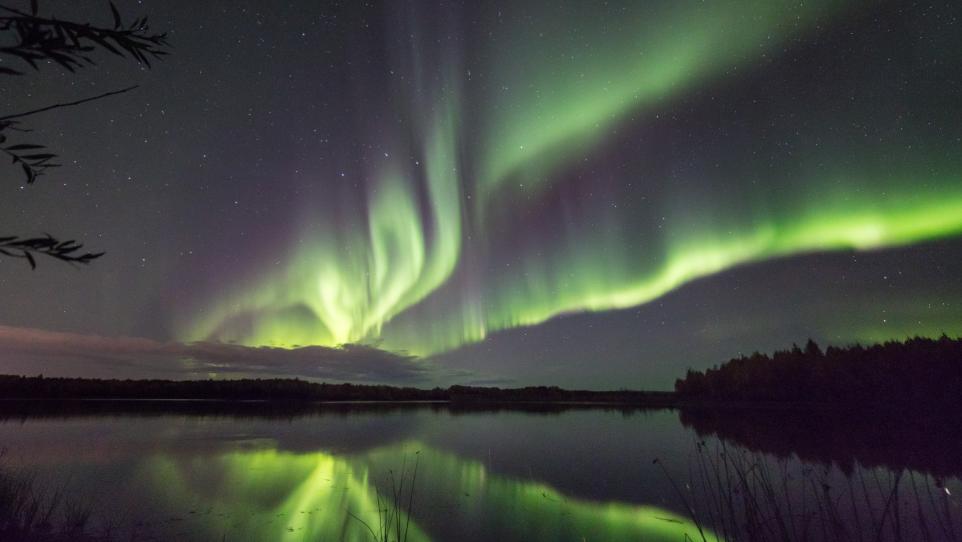
The aurora appears in a beautiful array of colors: green, red, pink, magenta, blue and sometimes, even white. In the most awe-inspiring display of science, the aurora occurs when gases in the Earth’s atmosphere interact with charged particles from the sun.
But why are the northern lights different colors? What is happening and why?
How the aurora happens
-
The sun sends out charged particles (mainly electrons and protons) in the solar wind. Think of solar wind as a wispy, fast-moving plasma “breeze” from the Sun.
-
The Earth’s magnetic field draws these particles towards the polar region, which is in the center of the Auroral Oval, very close to Fairbanks.
-
When these particles hit gases in the Earth’s atmosphere (oxygen and nitrogen), they transfer energy. This is where the magic happens!
-
The gases release this energy as light (photons), the northern lights.
What makes the aurora happen
-
Oxygen is the most important gas for auroras. At 75-110 miles from the Earth, oxygen produces green aurora, the most common color of aurora.
-
Altitude also plays an important role in the making and coloring of auroras. At higher altitudes, you’ll see red auroras, often at the top of green aurora bands. When the aurora is closer to the Earth, you’re more likely to see pink. Each color is a unique mix of gas, solar outflow, and height.
-
Solar outflow from the sun takes several forms, but Coronal Mass Ejections (CME) typically produce the most vibrant auroras. As gases in Earth’s atmosphere collide with particles from the sun, energy is released as colorful light, the aurora.
-
Nitrogen adds purple, blue and pink to auroras. Ionized nitrogen creates blue and violet aurora, while neutral nitrogen can create red or pink.
What do the colors mean?
The aurora can appear in a range of colors depending on the type of gas, altitude, and energy of the particles interacting with Earth’s atmosphere.
Auroras are full of science, and cultural symbolism too. Some believe that the aurora brings good fortune, while others see the aurora as a bad omen, animal spirits, and more. Across time, culture, and science, luck has always been an important part of aurora viewing. Now, visitors and locals alike share the feeling of luck and good fortune when they see the aurora.
-
Green is the most common aurora color, caused by oxygen at 75-110 miles above the Earth.
-
Red auroras happen when oxygen is present at a higher altitude (above 120 miles).
-
Pink auroras happen below 60 miles from the Earth when nitrogen is present.
-
Blue auroras are caused by nitrogen at 75-110 miles above the Earth.
-
Multicolor auroras often feature green paired with red, blue, or pink. When multiple colors appear, it means that particles from the sun are colliding with Earth’s gases at various altitudes. At times, layers of light can even appear as purple.
-
White and yellow auroras are less common and are usually seen as part of a larger aurora display. White and yellow auroras are often the result of diffused, softer light and color.
Common misconceptions about the aurora:
The cold changes the color of the aurora
No, cold weather does not change the color of the aurora. Cold weather often means fewer clouds, which does increase your chance of seeing the aurora.
The colors of the aurora come from the sun
No, solar flares from the sun do not change the colors of the aurora. The colors of the aurora are created when particles from the sun interact with oxygen and nitrogen at various altitudes within the Earth’s atmosphere.
Aurora only happens in the winter
No, aurora activity occurs year-round. Auroras are visible in the Fairbanks area for nine months between August 21 and April 21 when the sky is dark enough to see the northern lights. All aurora colors can occur all Aurora Season.
Why Fairbanks is the best place to see the Aurora
Fairbanks is directly under the Auroral Oval, a ring-shaped zone over the far north where aurora activity is concentrated. As a prime destination within the Auroral Oval, Fairbanks has a significant advantage over other locations when it comes to likelihood of seeing the aurora borealis. If you stay a minimum of three nights in the Fairbanks area and are actively out during the evening hours, your chances of seeing the aurora are more than 90%! Check out our Aurora Tracker to learn more!
Your guide to seeing the aurora
Science is an important part of understanding the aurora, but when you see it in person, it feels like magic. Seeing the aurora is an experience like no other, and a lifelong dream for many. In Fairbanks, this dream comes true.
Be sure to check out our Aurora Viewing Map & Guide for more info about how, when and where to see the aurora!
Sources: A Beginner’s Guide to Aurora Chasing, NASA Science Visualization Studio: Explore Auroras, NPS: The Colors of the Aurora, SPACE.com: Aurora Colors: What causes them and why do they vary?, UCAR: The Northern and Southern Lights, Center for Space Physics, Boston University, NOAA Space Weather Prediction Center: Aurora Tutorial, Compound Interest: What causes the colors of the aurora?, Chemistry Views: The Chemistry Behind the Aurora Borealis or Northern Lights, High Altitude Observatory: What are the aurorae?, The Mythology and Folklore of the Northern Lights - AFAR, NASA Auroras, Geophysical Institute: What Causes the Aurora?, UAF: Red Aurora is a rarity, NASA Color PDF

